Doom se ha portado con éxito a dispositivos no convencionales como tostadoras, refrigeradores y prácticamente cualquier dispositivo imaginable, lo que hace que la búsqueda de nuevas y llamativas plataformas capaces de ejecutar Doom sea cada vez más desafiante. Sin embargo, un innovador estudiante de secundaria ha logrado lo inesperado al incrustar un juego de Doom jugable dentro de un archivo PDF real, accesible directamente a través de tu navegador web.
Aunque esta versión carece de funciones convencionales como texto y sonido, eso importa poco cuando puedes disparar a través de E1M1 mientras aparentemente revisas esos olvidados documentos fiscales.
El avance proviene del usuario de GitHub ading2210, un programador de secundaria que se inspiró en TetrisPDF -un port reciente de Tetris basado en PDF- para llevar uno de los shooters en primera persona más icónicos de los videojuegos al formato de documento. El resultado funciona sin problemas en navegadores basados en Chromium.
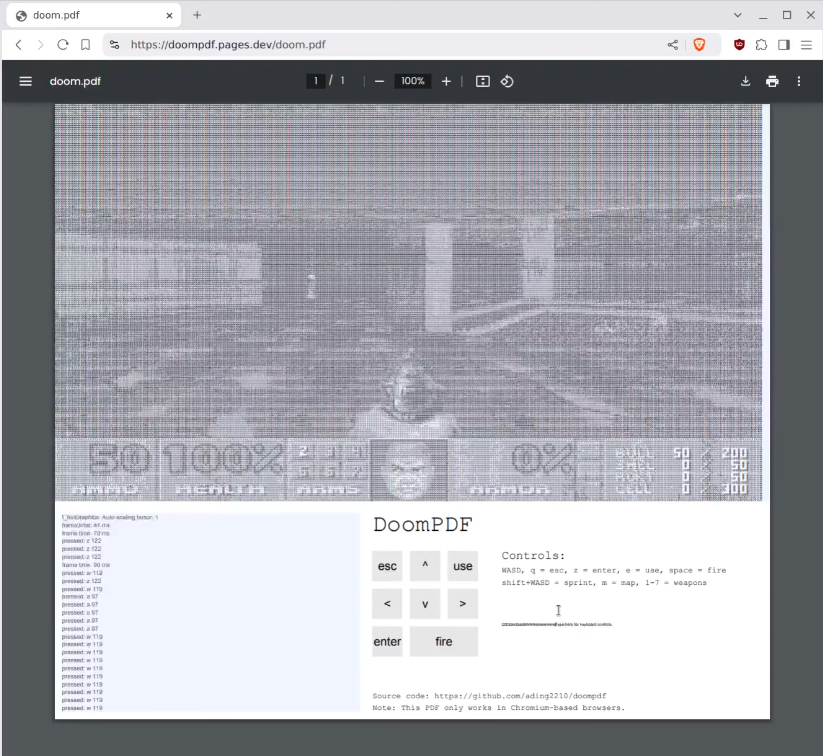
ading2210 utilizó ingeniosamente la funcionalidad JavaScript dentro de los visores de PDF basados en navegador para hacer posible este improbable port. Aunque las especificaciones oficiales de PDF permiten scripts más avanzados, las restricciones de seguridad de los navegadores modernos requirieron soluciones creativas. Sin embargo, la experiencia central de Doom permanece intacta.
El soporte de JavaScript de la especificación PDF le proporcionó a ading2210 "la libertad computacional necesaria" para lograr esta hazaña. La representación ASCII resultante de los gráficos de Doom, aunque simplificada y con seis colores, ofrece una versión sorprendentemente reconocible del clásico shooter, aunque con un retraso de 80ms en la renderización de fotogramas.
Si bien esta versión en PDF no reemplazará tu consola de juegos, el logro técnico es innegable. La claridad de la implementación es particularmente impresionante dada la plataforma no convencional.
Curiosamente, el creador de TetrisPDF, Thomas Rinsma, reveló en Hacker News que también había desarrollado su propio port de Doom basado en PDF, aunque reconoció que la implementación de ading2210 está "más pulida en varios aspectos".
Si bien esta versión no es ideal para jugadores novatos, la tradición continua de ejecutar Doom en plataformas cada vez más absurdas - desde archivos hasta sistemas biológicos - sigue cautivando a los entusiastas de la tecnología de todo el mundo.

Reviver Team's Photo Puzzle Game
An Interactive Puzzle Adventure Game Concept
🎮 Game Title: Reviver Team: Photo Puzzle Chronicles
Genre: Puzzle / Adventure / Narrative-Driven
Platform: Mobile (iOS/Android), PC (Steam), Console (Switch, PlayStation)
Target Audience: Puzzle enthusiasts, fans of story-driven games, casual and hard-core gamers alike
Developer: Reviver Team (Fictional indie studio with a flair for emotional storytelling and clever mechanics)
🎯 Game Concept:
In Reviver Team: Photo Puzzle Chronicles, you play as a member of the Reviver Team, a mysterious group of digital archivists who restore lost memories by reconstructing fragmented photographs from the past. Each puzzle isn't just a jigsaw—it’s a journey through forgotten moments, emotional truths, and hidden secrets tied to real people’s lives.
The twist? Each photo you solve re-awakens a memory in the real world, changing small details in the present—families reunite, forgotten promises are fulfilled, and long-lost friends reappear. But with every memory restored, reality shifts… and not always for the better.
📸 Core Gameplay:
Photo Reconstruction Puzzle Mechanics:
You’re presented with a broken photograph—split into fragmented tiles (like a jigsaw, but with dynamic elements).
Tiles are not just shape-based—each has:
Color shifts (e.g., a sunlit beach turns gray when the memory is painful),
Motion hints (parts of the photo “pulse” or flicker when a memory is near completion),
Emotion-based filters (a joyful memory might glow gold; a sad one, blue and dim).
Memory-Driven Challenges:
Solve the puzzle to unlock a memory scene (animated 3D vignette, not just static image).
The memory plays like a short cinematic with voiceovers, ambient sounds, and music.
After the memory plays, the real world changes:
A character appears at a park bench where they were last seen.
A letter appears in an envelope that wasn’t there before.
A door in a house opens that was locked for years.
Consequences System:
Every restoration has ripple effects.
Example: Reassembling a photo of two siblings arguing might reunite them… but cause another character to disappear, as their memory was tied to a lie that’s now broken.
You must decide: Restore the truth, or preserve the peace?
Reviver Team Abilities (Unlockable):
Echo Vision: See faint ghost images of the original photo’s full form.
Emotion Tuner: Adjust emotional tone to unlock hidden pieces (e.g., make a joyful scene sad to reveal a secret).
Timeline Thread: Reorder events in the photo to alter the story path.
🌍 Story & Setting:
Set in a near-future world where memories can be stored as digital “photo-frames” (a technology called Memosync), the Reviver Team operates in the shadows, fixing corrupted memories before they erase people’s identities.
You are Kai, a former photographer who joined the team after losing your own memories in a mysterious accident. You don’t know why you’re here—only that every time you solve a puzzle, a piece of your past returns… and it's not the one you expected.
As you progress:
Discover that the Reviver Team isn’t just fixing memories… they’re curating them.
Uncover that some people don’t want their memories restored—some are dangerous to know.
Face the truth: Was your own past erased… or chosen to be forgotten?
🎨 Visual & Audio Style:
Art Style: A blend of hyper-realistic photo textures with soft watercolor overlays for emotional scenes.
Music: Dynamic soundtrack that changes based on the memory’s mood—soft piano for nostalgia, distorted synth for trauma.
Voice Acting: Full cast of voice actors; each memory has unique dialogue, some recorded by real people (crowdsourced from memory submissions).
🧩 Key Features:
60+ photo puzzles (each based on real human-submitted memories, anonymized and adapted).
5 Acts, each centered on a different theme: Love, Loss, Betrayal, Redemption, Rebirth.
Daily Memory Challenges (online leaderboards, limited-time puzzles).
“Memory Vault”: A digital scrapbook you build as you solve puzzles—each photo you restore adds to your personal archive.
Co-op Mode: Play with a friend remotely—split a photo and solve it together using voice chat and hints.
🎁 Why It Stands Out:
Blends puzzle mechanics with emotional storytelling, like The Witness meets Life is Strange.
Uses real human memories (with consent) to create authenticity and depth.
Challenges players to think: What would you erase to be happy? What would you restore to be whole?
🔮 Tagline:
"Some memories are broken…
But the truth? It’s always hidden in the pieces."
📸 Launch Trailer Suggestion (Concept):
A child’s faded photo of a family picnic. Pieces float in the air. You move them. The image reforms: laughter, sunlight, a hand reaching out…
Then—click. The hand is gone.
A tear falls from the screen.
Voice (Kai): "I thought I remembered you…"
Fade to black.
Text: Reviver Team: Photo Puzzle Chronicles – Coming Soon.
🎮 Will you piece together the past… or break the present?
✨ Game by Reviver Team — Because every photo holds more than a face… it holds a soul. ✨
As of now, Assassin's Creed Shadows—the upcoming entry in the long-running Assassin’s Creed franchise—has not officially confirmed any romantic storyline, including a gay romance.
The game is set in 16th-century Japan, during the Sengoku period, and follows two protagonists: Naoe, a female ninja from the Iga clan, and Kaito, a male Assassin from the Hidden Ones (the precursor to the Assassin Brotherhood). The narrative centers on their personal journeys, the clash between the Assassins and the Templars (represented here by powerful daimyō and religious factions), and the political turmoil of feudal Japan.
While Assassin’s Creed Shadows features a strong emphasis on character development and personal conflict, there has been no official announcement from Ubisoft regarding a gay romance between Naoe and Kaito, or any other characters, nor has there been any in-game dialogue, cutscene, or promotional material confirming such a relationship.
That said, the Assassin’s Creed series has made strides in recent years toward inclusivity, with games like Assassin’s Creed Unity (2014) featuring a gay male character (Pascal), and Assassin’s Creed Valhalla (2020) including a same-sex romance between two female characters (Eivor and a woman named Freyja, though this was a player-choice romance). Ubisoft has also expressed a commitment to diverse representation, so a romantic subplot involving LGBTQ+ characters would not be entirely unexpected—especially in a game set in a historically rich and complex era like Edo-period Japan.
In short:
There is no confirmed gay romance in Assassin’s Creed Shadows at this time. Any claims or fan theories about such a relationship are speculative and not supported by official sources.
Stay tuned for more updates from Ubisoft, as the game is expected to release in 2024. If a romantic subplot is introduced, it will likely be revealed through official trailers, interviews, or in-game content.